Should I buy an electric tankless water heater? If you are looking for hot water on demand, want to save installation space, or are replacing an old geyser, an electric tankless water heater can be an interesting option. However, the right model depends on your water flow, electrical supply, water pressure, temperature requirement and how many people will use hot water at the same time.
Unlike a conventional storage water heater, an electric tankless water heater heats water as it passes through the appliance instead of keeping a large quantity of hot water stored in a tank. This can reduce standby heat loss and provide hot water on demand, but the heater must have sufficient electrical power for the required water flow and temperature rise.
Before buying, do not choose a model only because it has a higher kW rating or a lower price. Use the following 10 checks to determine whether an electric tankless water heater is suitable for your home, apartment, bathroom, kitchen or commercial application.
Table of Contents
- What Is an Electric Tankless Water Heater?
- Should I Buy an Electric Tankless Water Heater?
- 1. Check Your Hot Water Flow Rate
- 2. Check Electrical Power and Voltage
- 3. Consider Water Temperature and Heating Capacity
- 4. Check Water Pressure
- 5. Check Installation Space
- 6. Consider Your Water Quality
- 7. Understand Energy Consumption
- 8. Compare Initial Cost and Long-Term Value
- 9. Check Installation and Safety Requirements
- 10. Check Warranty, Service and Support
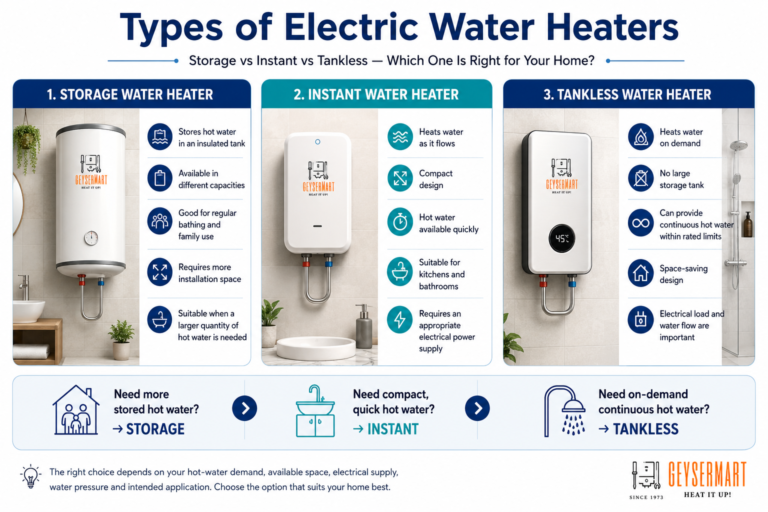
- Tankless vs Storage Water Heater
- Who Should Consider an Electric Tankless Water Heater?
- Final Buying Checklist
- Frequently Asked Questions
What Is an Electric Tankless Water Heater?
An electric tankless water heater is an on-demand water-heating appliance that heats water when it flows through the unit. Unlike a conventional storage geyser, it does not depend on a large tank of preheated water.
This design can make tankless water heaters compact and suitable for installations where space is limited. However, the heater’s output depends on factors such as its electrical power, incoming water temperature and water flow rate.
For Indian homes, it is particularly important to check the actual electrical requirement before buying. Some compact tankless models operate on single-phase electricity, while higher-power models may require three-phase electrical supply.
For information about Indian standards for electric instantaneous water heaters, you can refer to the Bureau of Indian Standards (BIS).
Should I Buy an Electric Tankless Water Heater?
An electric tankless water heater may be suitable if you want hot water on demand, have limited installation space, or need a continuous supply within the heater’s rated capacity.
However, it may not be the right choice for every household. A family that requires a large quantity of hot water at several outlets simultaneously may need a higher-power system, multiple units or a storage water heater depending on the installation.
The most important question is therefore not simply “Is a tankless water heater better?” but “Is the tankless water heater correctly sized for my application?”
1. Check Your Hot Water Flow Rate
Flow rate is one of the most important factors when selecting an electric tankless water heater. The heater has to raise the temperature of the water while it is flowing through the unit.
Before buying, consider:
- Shower flow rate
- Washbasin usage
- Kitchen usage
- Number of bathrooms
- Number of people using hot water
- Whether two outlets may operate simultaneously
A higher water flow generally requires more heating capacity to achieve the same outlet temperature. This is why selecting a tankless heater simply by looking at its kW rating can lead to disappointing performance.
2. Check Electrical Power and Voltage
This is one of the most important checks before purchasing an electric tankless water heater.
Tankless systems can require significant electrical power because they heat water while it is flowing. Check the product’s rated voltage, phase, kW rating, current requirement, recommended cable size and circuit protection.
Do not assume that an existing geyser connection can automatically support a higher-powered tankless model.
For example, GeyserMart currently offers tankless models ranging from compact units to high-power systems, including single-phase and three-phase options. Always check the individual product specification before installation.
Explore GeyserMart’s Online & Tankless Water Heater range.
3. Consider Water Temperature and Heating Capacity
The temperature you want at the shower outlet depends partly on the incoming cold-water temperature and the amount of water flowing through the heater.
If incoming water is colder or the flow rate is higher, more heating capacity may be required to achieve the desired outlet temperature.
This is especially important when selecting an electric tankless water heater for a shower rather than a washbasin or kitchen sink.
Electronic models with temperature sensors and automatic output control can help maintain a more consistent outlet temperature within their rated operating range. Manufacturers such as Stiebel Eltron describe electronic control systems designed to regulate instantaneous water heating according to operating conditions.
Read Stiebel Eltron’s information about instantaneous water-heater technology.
4. Check Water Pressure
Water pressure should be checked before purchasing any electric tankless water heater.
Look at the manufacturer’s minimum and maximum pressure specifications. This is particularly important in Mumbai apartments, high-rise buildings and homes using pressure pumps.
If your home uses a pressure pump, make sure the operating pressure remains within the water heater’s specified limits.
Never assume that every tankless model can handle the same pressure. Always check the technical specifications of the exact model.
5. Check Installation Space
One major advantage of an electric tankless water heater is its compact design compared with many storage geysers.
However, compact does not mean that installation requirements can be ignored.
Before purchasing, measure:
- Available wall space
- Distance from the water outlet
- Water inlet and outlet position
- Electrical connection location
- Accessibility for servicing
- Clearance required around the appliance
A professional installation assessment can help avoid problems after purchase.
6. Consider Your Water Quality
Water quality can affect water-heating equipment over time. Hard water can contribute to mineral or scale buildup, depending on the heater design and local water conditions.
Different heating technologies respond differently to water quality. For example, Stiebel Eltron explains that its instantaneous water heaters use different heating systems, including tubular and bare-wire heating technologies, with suitability depending partly on water characteristics.
For this reason, check the manufacturer’s recommendations if you live in a hard-water area.
7. Understand Energy Consumption
One common reason people consider an electric tankless water heater is the possibility of reducing standby losses because water is heated when required rather than continuously maintaining a large stored volume.
However, tankless does not mean that the appliance uses very little electricity while operating. A high-power electric tankless heater can draw substantial electrical power during active heating.
Your actual energy consumption depends on factors such as hot-water usage, water temperature, flow rate, heating capacity and operating time.
The U.S. Department of Energy describes tankless or demand-type water heaters as systems that provide hot water when required and avoid the standby losses associated with storage tanks.
Read more about energy-efficient water heating from the U.S. Department of Energy.
You can also read GeyserMart’s detailed comparison of tankless water heater and storage water heater power consumption.
8. Compare Initial Cost and Long-Term Value
The purchase price is only one part of the total cost of a water heater.
When comparing an electric tankless water heater, consider:
- Product price
- Electrical upgrade requirements
- Wiring and protection devices
- Plumbing changes
- Installation charges
- Maintenance requirements
- Warranty coverage
- Expected usage
A lower-priced heater may not necessarily be the most suitable if the electrical supply, water pressure or required flow rate is not compatible with the application.
9. Check Installation and Safety Requirements
Installation is an important part of buying an electric tankless water heater. The appliance should be installed according to the manufacturer’s instructions and applicable electrical and plumbing requirements.
Important considerations include proper earthing, suitable circuit protection, correct wiring, appropriate water connections and compliance with the manufacturer’s installation requirements.
Do not attempt to increase the electrical rating, change wiring or modify the appliance without qualified professional guidance.
If you are replacing a storage geyser with a high-power tankless model, have the electrical supply checked before ordering the appliance.
10. Check Warranty, Service and Support
A water heater is a long-term appliance, so after-sales support should be considered before purchase.
Check the manufacturer’s warranty, service availability, availability of genuine spare parts and the procedure for handling a product-related issue.
At GeyserMart, you can also compare different brands and technologies instead of limiting your selection to one model.
Read our guide: How to Choose the Right Geyser – 10 Things to Know Before Buying.
Electric Tankless Water Heater vs Storage Water Heater
| Feature | Electric Tankless Water Heater | Storage Water Heater |
|---|---|---|
| Water storage | Does not store a large quantity of hot water | Stores heated water in a tank |
| Hot water supply | Heats water on demand | Supplies water from the heated tank |
| Installation space | Usually compact | Requires space for the storage tank |
| Peak electrical demand | Can be high depending on kW rating | Usually lower instantaneous heating load |
| Standby heat loss | Little or no tank standby loss | Some heat loss from stored hot water |
| Selection factors | Flow rate, kW, temperature rise, pressure and electrical supply | Capacity, users, recovery time, pressure and installation |
Neither system is automatically suitable for every home. The right choice depends on your hot-water requirement and installation conditions.
Who Should Consider an Electric Tankless Water Heater?
An electric tankless water heater may be worth considering when:
- You have limited installation space.
- You prefer hot water to be heated on demand.
- You want to avoid maintaining a large storage tank.
- Your electrical supply can support the selected model.
- Your required water flow is within the heater’s rated capacity.
- You want a compact solution for a suitable bathroom, kitchen or point-of-use application.
A storage water heater may be more appropriate when your household requires a large quantity of hot water and your electrical supply is not designed for the high instantaneous load of a tankless system.
Final Buying Checklist
Before ordering an electric tankless water heater, check these points:
- Flow: Is the rated flow sufficient for your shower or outlet?
- Power: Can your electrical connection safely support the kW rating?
- Phase: Is the model single-phase or three-phase?
- Voltage: Does it match your electrical supply?
- Pressure: Is your water pressure within the manufacturer’s limits?
- Temperature: Can the heater achieve your required outlet temperature at your actual flow rate?
- Space: Is there enough room for installation and servicing?
- Water quality: Is the model suitable for your local water conditions?
- Safety: Are suitable earthing and electrical protection available?
- Service: Is manufacturer support available for the model?
If you are still unsure, it is better to check your site requirements before purchasing rather than choosing a water heater only from its price or kW rating.
Explore Electric Tankless Water Heaters at GeyserMart
GeyserMart offers a range of online and tankless water heaters for different applications, including compact household models and higher-power instantaneous systems.
You can also compare our storage water heaters and instant water heaters if you are not sure which technology is suitable for your home.
For example, GeyserMart currently lists tankless options from brands including Stiebel Eltron, Clage, Havells and Zanskar. Product requirements vary, so always check the individual model’s electrical, pressure, flow and installation specifications before purchasing.
Need help choosing? Contact GeyserMart with your number of bathrooms, number of users, water pressure, available electrical supply and intended application. These details can help narrow down the appropriate water-heater type and capacity.
Frequently Asked Questions About Electric Tankless Water Heaters
Is an electric tankless water heater good for a bathroom?
An electric tankless water heater can be suitable for a bathroom when its flow rate, heating capacity, electrical supply and water-pressure requirements match the application. Check the manufacturer’s specifications before selecting a model.
Does an electric tankless water heater use more electricity?
A tankless heater can have a high instantaneous electrical demand because it heats water while it flows. However, it can avoid the standby heat losses associated with storing hot water. Actual electricity consumption depends on usage, flow rate, temperature rise and operating time.
What kW electric tankless water heater should I buy?
The required kW depends on your water flow, incoming water temperature and desired outlet temperature. A higher kW rating is not automatically better if your electrical connection cannot safely support it.
Can I install a tankless water heater with a pressure pump?
It may be possible, but the water pressure must remain within the manufacturer’s specified operating range. Check the maximum pressure rating of the exact water heater and the pressure produced by your pump.
Does a tankless water heater provide unlimited hot water?
A tankless water heater can continue heating water while it is operating, but the available hot-water flow is limited by the heater’s power, temperature rise and rated flow capacity. It should not be described as unlimited under every condition.
Is an electric tankless water heater suitable for multiple bathrooms?
It depends on the model and whether multiple outlets will operate simultaneously. Multiple bathrooms can require substantially more heating capacity and electrical power, so the total simultaneous flow should be calculated before selecting a system.
Are tankless and instant water heaters the same?
The terms are often used interchangeably because both can heat water as it passes through the appliance. However, models can differ significantly in power rating, control technology, flow capacity, installation requirements and intended application.
Should I buy an electric tankless water heater or a storage geyser?
The answer depends on your application. A tankless model can be useful where compact size and on-demand heating are important and the electrical supply is suitable. A storage water heater can be useful where a larger quantity of hot water is required and a storage tank is acceptable.
Still unsure which water heater to choose? Contact GeyserMart and share your application details so you can compare the suitable water-heating options before purchasing.